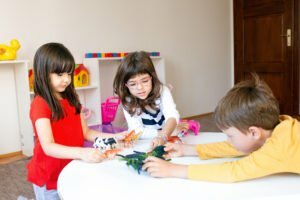
Kindness is a great skill for kids (or anyone) to have. (We have talked about the benefits of kindness in another post.) But it is actually a pretty big concept. Oxford University Press defines kindness as “the act of being friendly, generous, and considerate”. That’s a lot of things. So just telling kids to “be kind” does not tell them how to do that. Here are 4 concrete steps you can take to help your child learn to be kind.
- Talk about what being kind looks like. In order to be kind, your child needs examples of what that looks like. Now that your child is noticing people, you could say something like “Do you see your friend has a fun striped shirt on? It would be kind to tell him that his shirt is cool.” Or you could notice someone’s feeling “Your classmate is crying. I wonder if he is sad because he doesn’t have any crayons. It would be kind to share your crayons with him.” And it is important to point out when someone is kind to your child. For example, “Jane just shared her cookie with you. She was being kind.” You can also point out characters being kind to each other in books or videos. The more examples, the better to help your child learn the many ways that it is possible to be kind.
- Talk about how it feels when someone is kind to you. When we know that we are helping others to feel good, we feel good, too, and we are more likely to be kind in the future. Let your child know how it feels when someone is kind. You could say something like “I was feeling a little sad this morning and my friend told me that she liked my sweater. That was kind and it made me feel happier”. You can also ask your child how they feel when someone is kind to them, and let them know that when they are kind, it makes it more likely that others will be kind to them.
- Notice other people. If we are not paying attention to the people around us, we probably will not even think about how to be kind. Teach your child to look at others and notice how they are feeling. You can do this with picture books, videos, as well as real people. For example, if you are reading a book and a character is smiling, you could ask “How do you think they feel?” You can also “people watch” when you are out and about. Just noticing small details can be fun. For example, you might point out that someone is wearing a blue coat or walking with a small dog. (Bonus: You can practice all sorts of vocabulary here for descriptions of shapes, colors and lots of other things.)
- Reinforce your child for being kind. When you see your child being kind, let them know that you noticed and that you appreciate it. It helps to label what you saw so that your child will know how to do it again. So if they just shared their toy with a friend, you could say “When you let your friend play with your toy just now, you did a great job of being kind. Way to go!” or if they helped you out in some way, “Thank you for helping me. You were being very kind and it made me feel good.”
Being kind is good for everyone and can help your child to be more successful in school (and life).
[divider type=”standard” text=”Go to top” full_width=”no” width=”1/1″ el_position=”first last”]
Text: © Kids In Transition to School
Image: © Johnathon Novak | Dreamstime.com